Showing posts with label Pattern of Reactivity. Show all posts

Saturday, 30 November 2013

CHECKPOINT _ Chemistry : Rusting Seatwork

Worksheet 

Rusting of iron


NAME : _________________________       DAY, DATE   :  _________________________________


1 Rusting of a car can only happen when oxygen and water are able to get at the iron metal. The iron will then form iron oxide. The iron oxide flakes off and the metal underneath begins to rust.


a Why might a rusty car be dangerous?

b What could you do to protect a car from rust?

c Write a word equation for the chemical reaction that forms rust.


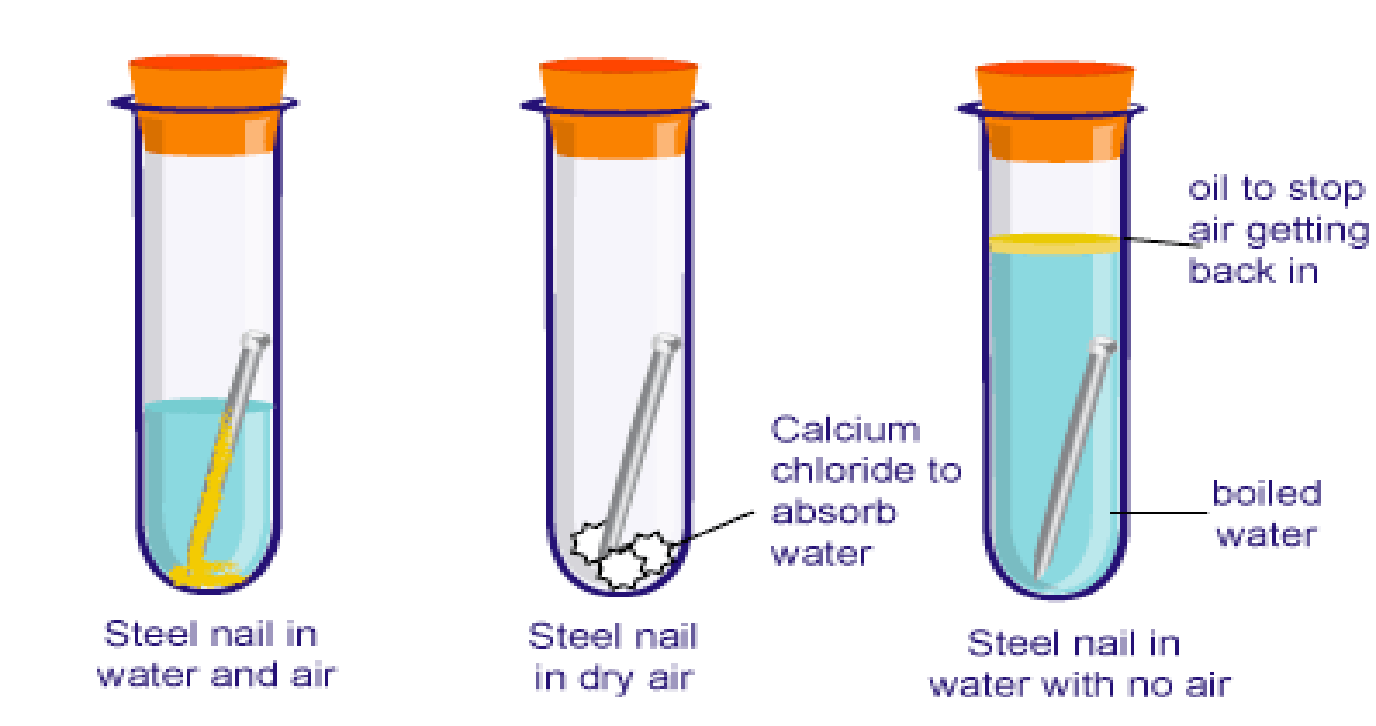
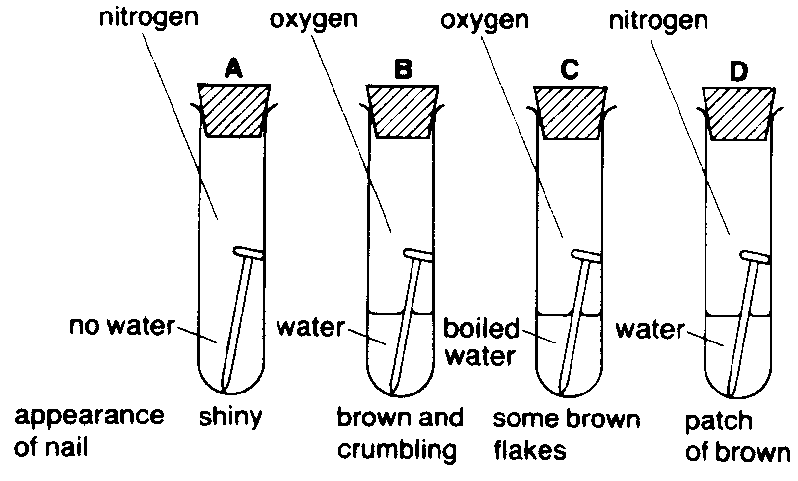
2 The diagrams show the results of an experiment about corrosion.


a Which nail has corroded the most?


b Which nail has not corroded? 


c From the experiment, what substances are needed before iron will corrode? 


d Give three ways of slowing down or stopping corrosion of iron. 


Rustiong of Iron Investigation

Rusting Investigation


Collect the following: -

  • 5 test tubes

  • 1 beaker

  • Cotton wall

  • 1 painted iron nail

  • 4 normal nails

  • 6 labels


Carry out the following five experiments – make sure you label each test tube, and label the beaker with all your test tubes in with your group name


Experiment 1

Place the painted nail in a test tube and totally cover with water – label this painted nail + water


Experiment 2

Put a plain nail in a test tube and ½ cover this with water – label this control


Experiment 3

Cover a plain nail in Vaseline (using a paper towel) and totally cover with water – label this greased nail


Experiment 4

Add some calcium chloride crystals in a test tube, and add a little cotton wool in the top of the test tube, pushing it down with a spatula so that it is just above the crystals. Add a plain nail on top of the cotton wool, and place some more cotton wool in the top of the test tube – label this calcium chloride


Experiment 5

Put a plain nail in a test tube and totally cover this with boiled water. Add a little oil on top of the water, and bung the test tube – label this oil


Wednesday, 13 November 2013

Rusting of Iron Quiz (answered)

Name/# /ClASS      : MARKS:

DAY, DATE :

Answer the following questions briefly on your “kertas ulangan”, then fasten the question sheet and the answer sheet securely together. You are not allowed to use any correction tools. There are 40 marks possibly. 


  1. Define the meaning of :

    1.  “corrosion”  and  “rusting”, what are the differences the both terms.   [4 marks]

    2. Why  the rusting of iron is called a slow reaction [3 mark]


  1. Write chemical equiation for:

  1. the oxidation of iron atoms to iron(II) ions. [2 marks]

Fe(s) 🡪 Fe2+(aq)    +    2e-

  1. the reduction of oxygen in the presence of water to form hydroxide ions. [2 marks]

O2(g)   +   2H2O(l)   +   4e-      ðŸ¡ª     4OH-(aq)


  1. Suggest why no corrosion has occurred in tube 2. [3 marks]

keyword: free moisture/dry air

  1. Suggest why no corrosion has occurred in tube 3. [3 marks]

Keyword: boiled water—free O2; preventing by oil layer


  1. Suggest why there is more corrosion in tube 4 than in tube 1. [3 marks] keyword: compare the oxygen content of the both tube.


  1. Suggest why corrosion of an iron object is reduced (or stopped) in each of the following situations.

  1. Outer space [2 marks] keyword: no oxygen

  2. At the bottom of the ocean. [2 marks] keyword: limited/lack of oxygen

  3. When the object is coated with oil. [2 marks] keyword: oil prevent O2 and H2O away from the metals


  1. Metal rubbish bins are often coated with zinc. Metal food containers are coated with tin.

  1. Why the zinc coating on rubbish bins protects the iron from corrosion. [3 marks] keyword: reactivity

  2. Why is a zinc coating not suitable for use on food containers? [3 marks] keyword: rust; healthy


  1. Complete this table showing whether there is rusting or not, and if it occurs, whether the corrosion is slow, fast or very fast. [4 marks]


Speed of corrosion

Water

Air

Salt

a.

x

x

b.

x

x

c.

x

d.

Keyword: rust : the present of O2 and water

  1. Why does iron corrode faster/very fast in previous questions (no. 8) [2 marks] keyword: catalyst


Why are pieces of household equipment packed in cartons with a sachet of silica gel? [2 marks] keyword: drying agent; good maintenan

Wednesday, 9 October 2013

singe displacement reaction worksheet

complete this reactions. then convert into word equations
1.Ag + KNO3 →      
2. Zn + AgNO3 →      
3. Cl2 + KI →      
4. Cu + FeSO4 →      
5. Fe + Pb(NO3)2 →      
6. Cu + Al2(SO4)3 →      
7. Al + Pb(NO3)2        
8. Cl2 + NaI →      
9. Fe + AgC2H3O2      
10. Al + CuCl2 →        
11. Br2 + CaI2 →        
12. Fe + CuSO4 →        
13. Cl2 + MgI2 →        

Wednesday, 25 September 2013

Pattern of Reactivity Quiz

REACTIVITY SERIES - Chem is try  2
Workout these questions with your learning partner. There are 40 marks possibly.


1)      Answer the following questions in full sentences.
a)     Why does gold occur native (uncombined) whereas zinc does not?
………………………………………………………………………………………………
b)     Why was silver used to make coins in the past?
………………………………………………………………………………………………
c)      Why is copper used to make electrical cables and wires?
………………………………………………………………………………………………
 (3)
  2)      The following metals are listed in order of reactivity (most reactive first)
sodium  >  magnesium  >  zinc  >  copper
a)     Describe what each metal does when
(i)    heated in air  …………………………………………………………..
(ii)  added to dilute hydrochloric acid……………………………………..
b)     Which of the four metals would be suitable for making saucepans?  Explain why the others are not.
………………………………………………………………………………………………
………………………………………………………………………………………………
(5)

3)     Describe what you would see if you dropped a piece of magnesium ribbon into some copper sulphate solution in a test tube.  Write a word equation for the reaction.
………………………………………………………………………………………………
……………………………………………………………………………………………...
………………………………………………………………………………………………
………………………………………………………………………………………………
(3)

4)     Complete the following word equations.
a)     zinc   +   lead nitrate solution  ………………………………………………………….
b)     iron   +   zinc sulphate solution  ………………………………………………………..
c)      lead   +   copper nitrate solution ………………………………………………………
d)     magnesium   +   zinc chloride solution  ………………………………………………..
e)     copper   +   sodium chloride solution  …………………………………………………
f)       zinc   +   iron sulphate solution  ………………………………………………………..
g)     gold   +   silver nitrate solution  ………………………………………………………..
h)     magnesium   +  calcium nitrate solution  ……………………………………………..
(8)
5)     Three metals X, Y and Z have the following reactions:-
Y will displace X from a solution of its salt.
Z will displace both X and Y from solutions of their salts.
Place the three metals in order of reactivity, starting with the least reactive.
………………………………………………………………………………………………
(2)

6)     Here is a list of metals in order of decreasing reactivity.  Q and R are mystery metals.
K > Q > Ca > Mg > Al > Zn > R > Fe > Cu
a)     Will Q react with cold water?                                                              …………
b)     Will R react with cold water?                                                                              …………
c)      Will R react with dilute hydrochloric acid?                                 ...……….
d)     Will R displace copper from copper sulphate solution?    ...……….
e)     Write word equations for any reactions in parts a) to d)
………………………………………………………………………………………………….
………………………………………………………………………………………………….
………………………………………………………………………………………………….
………………………………………………………………………………………………….
(6)
7)     Describe everything you see when sodium is added to water containing universal indicator.

Name the two chemical products of sodium reacting with water and give the symbol equation for the reaction of sodium with water.
(3)
8)     (a) Give two observations that could be made after adding zinc to copper(II) sulphate solution.

(b) Give the symbol equation for the reaction between zinc and copper(II) sulphate solution.

(4)
(c) explain why this is an example of a displacement reaction.

  9   (a) Give three observations that could be made when magnesium reacts with sulphuric acid.
     (b) Give the word and symbol equation for zinc reacting with sulphuric acid.
     (c) From copper, iron, magnesium and zinc: Which reacts with acid (i) fastest?, (ii)slowest?
(6)

Recent Posts

Contact Form

Name

Email *

Message *