
Showing posts with label rusting. Show all posts
Showing posts with label rusting. Show all posts
Saturday, 30 November 2013
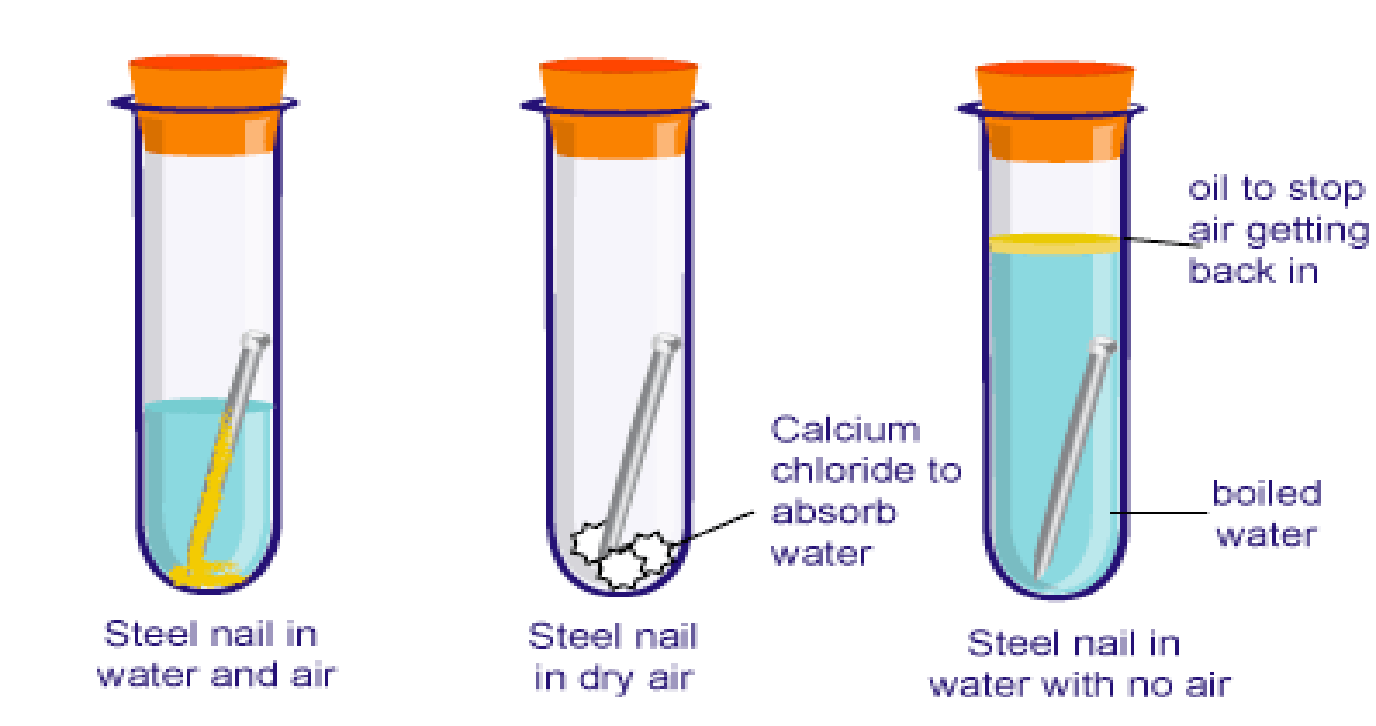
Rustiong of Iron Investigation
Rusting Investigation
Collect the following: -
5 test tubes
1 beaker
Cotton wall
1 painted iron nail
4 normal nails
6 labels
Carry out the following five experiments – make sure you label each test tube, and label the beaker with all your test tubes in with your group name
Experiment 1
Place the painted nail in a test tube and totally cover with water – label this painted nail + water
Experiment 2
Put a plain nail in a test tube and ½ cover this with water – label this control
Experiment 3
Cover a plain nail in Vaseline (using a paper towel) and totally cover with water – label this greased nail
Experiment 4
Add some calcium chloride crystals in a test tube, and add a little cotton wool in the top of the test tube, pushing it down with a spatula so that it is just above the crystals. Add a plain nail on top of the cotton wool, and place some more cotton wool in the top of the test tube – label this calcium chloride
Experiment 5
Put a plain nail in a test tube and totally cover this with boiled water. Add a little oil on top of the water, and bung the test tube – label this oil
Wednesday, 13 November 2013

Rusting of Iron Quiz (answered)
Name/# /ClASS : MARKS:
DAY, DATE :


Write chemical equiation for:
the oxidation of iron atoms to iron(II) ions. [2 marks]
Fe(s) 🡪 Fe2+(aq) + 2e-
the reduction of oxygen in the presence of water to form hydroxide ions. [2 marks]
O2(g) + 2H2O(l) + 4e- 🡪 4OH-(aq)
Suggest why no corrosion has occurred in tube 2. [3 marks]
keyword: free moisture/dry air
Suggest why no corrosion has occurred in tube 3. [3 marks]
Keyword: boiled water—free O2; preventing by oil layer
Suggest why there is more corrosion in tube 4 than in tube 1. [3 marks] keyword: compare the oxygen content of the both tube.
Suggest why corrosion of an iron object is reduced (or stopped) in each of the following situations.
Outer space [2 marks] keyword: no oxygen
At the bottom of the ocean. [2 marks] keyword: limited/lack of oxygen
When the object is coated with oil. [2 marks] keyword: oil prevent O2 and H2O away from the metals
Metal rubbish bins are often coated with zinc. Metal food containers are coated with tin.
Why the zinc coating on rubbish bins protects the iron from corrosion. [3 marks] keyword: reactivity
Why is a zinc coating not suitable for use on food containers? [3 marks] keyword: rust; healthy
Complete this table showing whether there is rusting or not, and if it occurs, whether the corrosion is slow, fast or very fast. [4 marks]
Keyword: rust : the present of O2 and water
Why does iron corrode faster/very fast in previous questions (no. 8) [2 marks] keyword: catalyst
Why are pieces of household equipment packed in cartons with a sachet of silica gel? [2 marks] keyword: drying agent; good maintenan

