Friday, 23 May 2014

Chemical Bonding Quiz

The table below shows the number of protons in elements P and Q.


       Element

Number of protons

P

3

Q

11

The reactivity of the reaction between element Q and chlorine is higher than the reactivity of the reaction between element P and chlorine.

  1. State the group that elements P and Q belong to in the Periodic Table.

  2. State the period that element Q belongs to in the periodic table.

  3. Element P reacts with chlorine to form a compound.

    1. What type of compound is formed?

    2. Write the formula of the compound that is formed.

    3. Draw the electron arrangement of the compound that is formed.

  4. Element Q reacts more vigorously than element P.  Explain this occurrence in terms of the electron arrangement.

  5. Element R has a proton number of 2 and a nucleon number of 4. Explain why element R does not react with element Q.
Tuesday, 13 May 2014

Stoichiometry of Solutions Presentation (ppt)

Solution and Suspension PPT part2

Slides presentation part-2
Click here to download

Solution and Suspension PPT - part1

Solutions and Suspensions
part 1 – Matter, Solutions


Kalam Kudus Christian School

Chemistry Checkpoint 2

Mr. Markus


Pure Substance


  • A type of matter in which all particles are of the same chemical composition (element, compound)

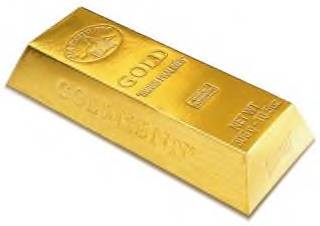
    • Au (pure gold)

    • H2O

    • NaCl

    • Sugar (C6H12O6)

    • Ar

  • Which of the previous examples is a compound?  an element?

  • Why is salt water not a pure substance?

01-gold-bar.jpg

Mixtures


  • Two or more pure substances physically mixed together.

  • Cannot be represented by a chemical formula.

    • Salt water

    • Sand and rocks

    • Air


Beakers

Heterogeneous Mixture


  • A mixture where substances are not evenly distributed (non uniform)

    • oil and vinegar salad dressing

    • vegetable soup

    • sand and sugar

    • soil

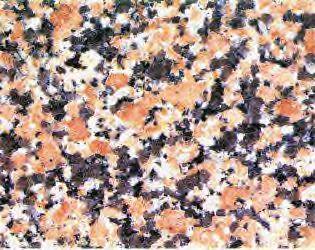
    • granite

Sample of Granitegranite

Homogeneous Mixture (Solution)


  • A mixture where all components are evenly distributed (uniform).

  • “same throughout”

    • salt water

    • gasoline

    • syrup

    • air

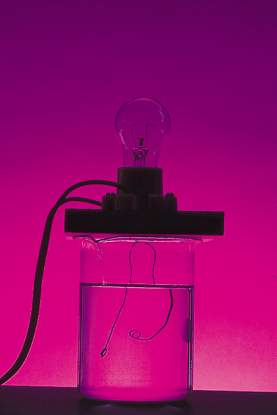
Battery-jar-water-beaker

Practice


  • Identify each of the following as:

    • pure substance/mixture

    • element/compound


mlcls

Definition of Solutions


  • A solution is a homogeneous mixture in which one substance is dissolved in another substance

  • The solute is(are) the substance(s) present in the lesser amount(s), dissolved by the solvent

  • The solvent is the substance present in the larger amount, does the dissolving/dissolves the solute


Solution


  • Formed when one substance is dissolved by another.

  • In order to be dissolved, a substance must be soluble.

  • A homogeneous mixture.

  • Particles are evenly distributed.

  • Parts cannot be separated by filtering.

  • Solvent—does the dissolving

  • Solute—dissolved by the solvent


180px-SaltInWaterSolutionLiquid

Solution Practice


  • Identify the solute and solvent in each of the following:

    • Salt water

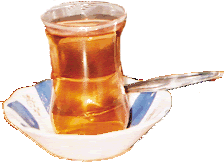
    • Iced tea

    • Coca-cola coke

    • Paint/paint thinner

    • Nail polish/acetone

    • Ethanol


Tea_Glass3

Types of Solutions

Kirk_effect
  • Solid dissolved in a liquid.

    • Salt water

  • Gas dissolved in a liquid

    • Coca-cola

  • Two solids

    • Metal alloys: brass = copper + zinc

  • Two gases

    • Air: nitrogen (78% vol), oxygen (21% vol), argon (1% vol), carbon dioxide (0.03% vol).

  • In solutions of 2 solids or 2 gases, the solvent is the component present in largest quantity. 


IONIC COMPOUNDS
Compounds in Aqueous Solution


Many reactions involve ionic compounds, especially reactions in water — aqueous solutions.


K+(aq)  +  MnO4-(aq)


KMnO4 in water


Aqueous Solutions


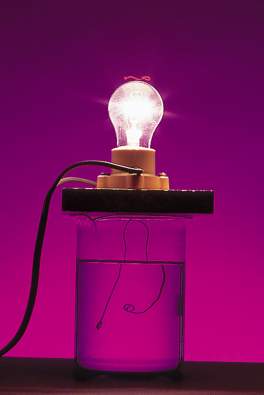
How do we know ions are present in aqueous solutions?


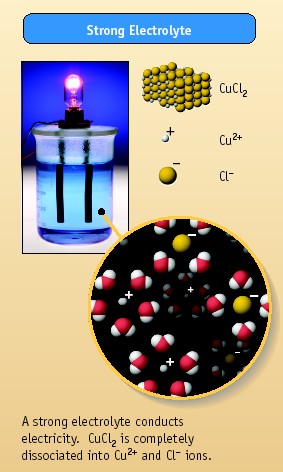
They are called ELECTROLYTES

HCl, MgCl2, and NaCl are strong electrolytes. They dissociate completely (or nearly so) into ions.


Aqueous Solutions


Some compounds dissolve in water but do not conduct electricity.  They are called nonelectrolytes.


Examples include:

sugar

ethanol

ethylene glycol


npo00008anpo00008cnpo000088

nonelectrolyte


weak electrolyte


strong electrolyte


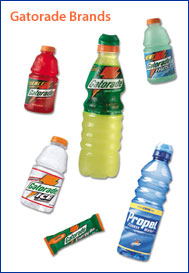
Electrolytes in the Body


Make your own

50-70 g sugar

One liter of warm water

Pinch of salt

200ml of sugar free fruit squash

Mix, cool and drink


  • Carry messages to and from the brain as electrical signals

  • Maintain cellular function with the correct concentrations electrolytes

gatorade_products


Monday, 5 May 2014

Electrolysis Revision Questions

Wednesday, 2 April 2014

Redox Worksheet

Friday, 28 March 2014

IGCSE Chemistry-Rate of reaction worksheet

Nuclear Atom Quiz

The Nuclear Atom
  1. The diagram represents an atom.


            a. What name is given to the central part of the atom?
            b. What particles make up this central part?
            c. What particles orbit around the central part?
            d. Which part of the atom has most of its mass?
            e. Atoms are small. Roughly how many, placed in a line, would occupy one millimetre – a
                thousand, a million, a billion or a trillion?
        2. The nucleus of an atom of nitrogen is represented by the symbol:
            a. How many nucleons are there in this nucleus?
            b. What is the proton number of this nucleus and what is its neutron number?

            c. How many electrons are there in a neutral atom of this second isotope?


        3. The diagram shows what happens when alpha particles pass close to the nucleus of a gold atom.


            a. Explain why the path of an alpha particle may bend as it passes close to a gold nucleus.

            b. Explain why one of the alpha particles is undeflected.

            c. One alpha particle has been ‘back-scattered’. Explain why this has happened.


Recent Posts

Contact Form

Name

Email *

Message *